Fireflies
Team: Riya Rao & Naomi Crowder
Timeline: Apr 26, 2025 - Apr 27, 2025
Brief: This project was completed during the Mindshifts on Megafires Design-A-Thon. The theme was Communicating Complex Risks in a Changing Fire Landscape. A special thanks to San Diego Gas & Electric, Wifire, Societal Computing and Innovation Lab, San Diego Supercomputer Center, UCSD Basement, Blackstone Launchpad, and UCSD Design Lab for this opportunity. My team won first place for our concept.
The Problem: How might we design more effective ways to communicate these dynamic and evolving risks to the people who need to understand and respond to them — residents, first responders, elected officials, and others — before, during, and after a wildfire event?
Design Challenge: Design a concept for how to communicate these risks. This could take many forms, from an app to a public information campaign to a real-time alert system. Think expansively and inclusively; proposals can take unconventional approaches.
Problem
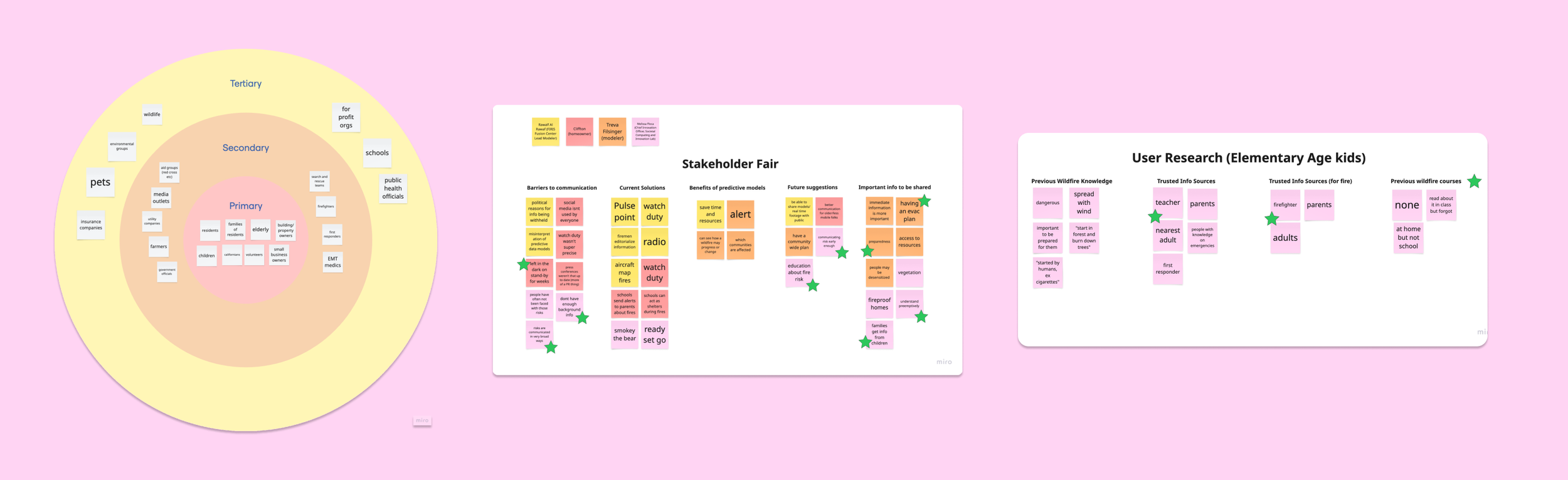
Getting to the Problem: Our research process began by identifying potential audiences: residents, the elderly, and children. We then began to narrow our focus through a series of stakeholder interviews. We spoke with four stakeholders, including three affiliated with WiFire and one homeowner directly impacted by the Palisades fires, uncovering key themes around barriers to communication, existing solutions, and opportunities for improvement. Three findings stood out: a widespread lack of wildfire preparedness, the outsized role children can play as communication channels within their households, and the importance of understanding risks before disaster strikes. These insights pointed us toward children as our primary audience, which we validated through user research with five elementary-aged kids. Those conversations revealed that schools largely leave children underprepared for wildfires, that kids look to parents, teachers, and officials as trusted information sources, and that most had little foundational knowledge about fire at all. From there, we defined our target audience as children in grades K–3 across California.
Problem Statement: How might we empower children in grades k-3 to understand, engage with, and remember wildfire preparedness, while also serving as messengers for spreading awareness and building knowledge within their families?
Exploration
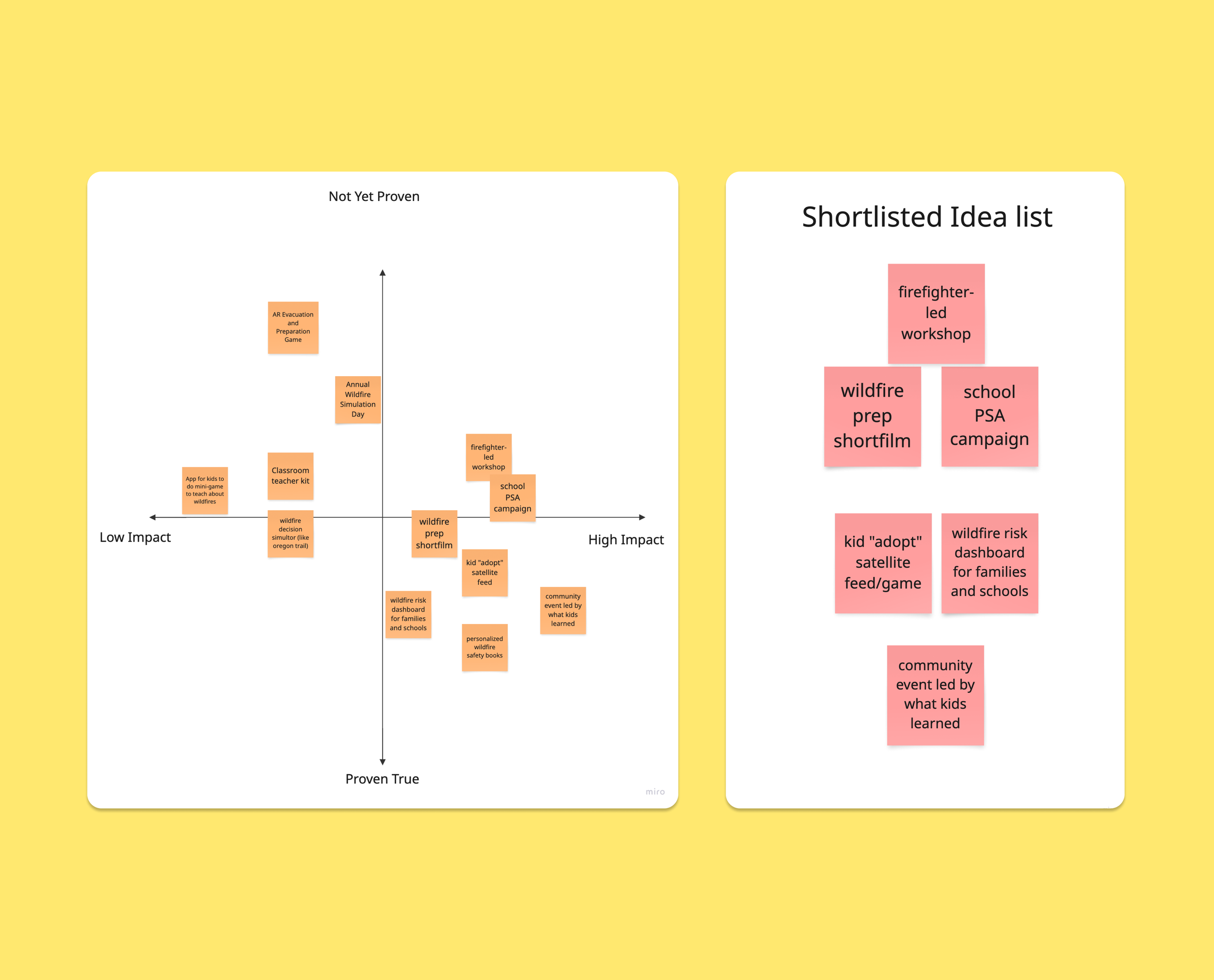
To evaluate our ideas, we used an assumptions chart to map potential solutions by impact and research backing, then shortlisted our top concepts and organized them across three stages of the educational process: in-school assemblies, at-home family games, and student-led community education events. We ultimately settled on gamified learning, supported by research showing it significantly enhances both engagement and knowledge retention in young audiences. Children proved to be an especially strong target for this approach — studies show they are more malleable, curious, and retain information more precisely than adults, confirming that an educational intervention would be most effective at this age. Beyond just reaching kids, we also recognized that children act as conduits into their households, bringing what they learn back to their families and influencing real behavioral change. Just as parents shape children, children shape their parents, meaning that teaching kids about wildfire preparedness can directly improve how their families prepare as well.
Solution
We came up with an interactive, gamified learning platform to teach children in grades K–3 about wildfire preparedness in a fun and approachable way. The goal is to empower kids to feel prepared and capable of helping their families during an emergency, while also supporting them in processing the emotions that arise in stressful situations. Beyond the individual learner, the platform has ripple effects—families can absorb knowledge by proxy—making it a resource that can be used both inside and outside the classroom. We called this “Fireflies”.
User Testing
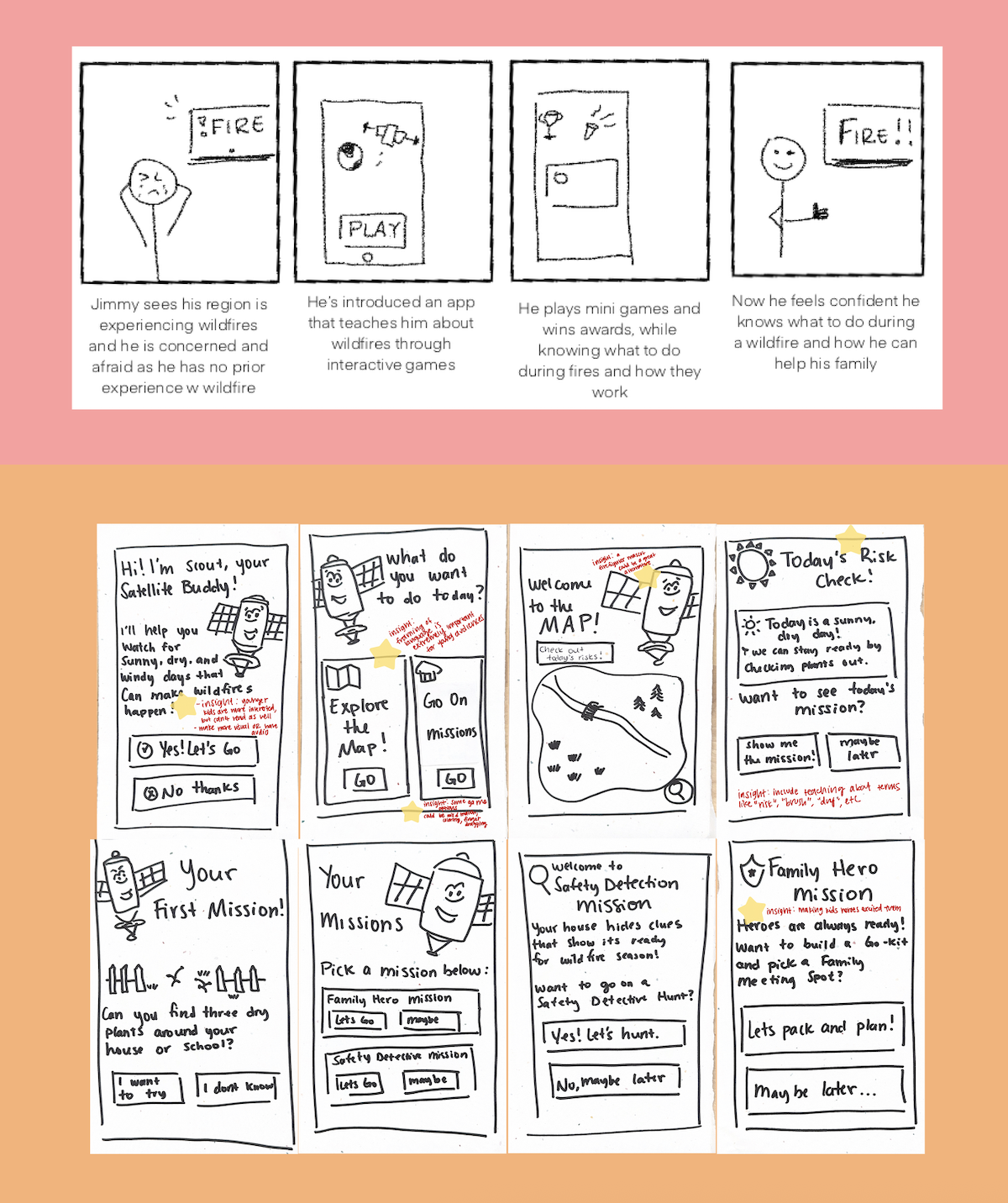
We first storyboard tested our concept with Tolga Caglar (computational data science researcher and father) before creating a prototype.
Key Finding: He mentioned it would be good to pay attention to our target audience’s reading level (perhaps incorporate more visual or audio aspects).
Key Finding: He saw potential in the game aspect as a motivator for kids to want to engage with the material.
Next, we focused on testing preliminary interest rather than full game flow by creating a paper prototype and conducting interviews with 4 children and 5 adults.
Key Finding: 4/4 kids were more interested in a “mission” over the “map”, so the way information is framed influences how likely children are to play/learn ➡️ language is a huge factor.
Key Finding: younger children (K) are more interested in playing than older, so making it more visual is important.
Key Finding: 4/4 kids wanted to continue playing the game after testing.
Key Finding: 5/5 adults felt this was an effective method to teach their children.
🥡 Takeaways and Next Steps
Because my team won first place, we get to explore this idea further through an internship with the Societal Computing and Innovation Lab at the San Diego Supercomputer Center. Our plan of action includes: researching more about what wildfire concepts are important to teach to this age group, how to design in a manner that is both engaging and effective for information retention, how to design for diverse cognitive needs, developing a story for our game, creating a design system, prototyping, and testing.
It was a great experience trying to solve such a complex problem in such a short period of time. It’s important to pay attention to neglected groups and create ways for them to access the same kind of information in a way that suits them. Getting to test with children gave me my first experience of designing for a cognitive group I am not a part of. I’m excited to see this concept come to life.